
 570.371.4760

WELCOME TO THE SHOHOLA AREA HISTORICAL INFORMATION WEB PAGE FROM PIKE COUNTY, PA.
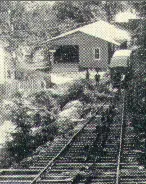 Shohola, the Lenni Lenape native American word for “Place of Peace”, shares the name of aTownship, Creek, and Village on the Delaware River. The name is also used to identify a Waterfall,Lake, a railroad depot and stone arch viaduct, a sawmill, hotel and store, a three span steel arch truss bridge, and the first suspension bridge to cross the Delaware River. Shohola also identifies an elementary school, post office and summer camp , as well as a railroad caboose, Fire and Rescue Department, and one of the most tragic railroad accidents in history. Finally, it names a large flat mystical bluestone and one of the first summer resorts or amusement parks in the United States and its grand Switchback Gravity Railroad , the Shohola Glen Amusement Park, “The Queen of Summer Resorts.”


The township was formed in December of 1851 from parts of Milford, Lackawaxen and Westfall Townships and is located along the Delaware River in Pike County Pennsylvania. It includes the communities of Shohola, Shohola Falls, Shohola Glen, Shohola Valley, McKean Valley, Hess Town, Twin Lakes, Walker Lake, Woodtown, Upland, Bee Hollow, Middaugh’s Valley, Pond Eddy, Handsome Eddy, Parker’s Glen or Carr’s Rock, German Hill, Hemlock Hill, Panther Brook, Lakeview Farm, Mountain View or Shohola Heights and Sunset Hill. Six of the communities supported schools, Shohola, Parker’s Glen, Pond Eddy, Middaugh’s, McKean Valley and Woodtown also serving Twin Lakes and Walker Lake. The Shohola school also served the communities of German Hill, Hemlock Hill and Handsome Eddy. A unified township school was build in 1916 in Shohola Glen resulting in the closing of the community schools shortly thereafter. Three of the original community school houses still exist. In 1991 the third Shohola Elementary School located on the east side of Twin Lakes Road, in Twin Lakes was dedicated.
Four township creeks empty into the Delaware River, Panther Creek, Shohola Creek with Taylortown Creek, Twin Lakes Creek with Walker Lake Creek, and Pond Eddy Creek. There were saw mills located on all four creeks where the water dropped into the Delaware River. The highest point in the township is Bald Hill at 1520 feet and the lowest is the Delaware River south of Pond Eddy. Almost half of the Township is public land including State Forest, State Game land, National Park Service land and township properties. All of Shohola Township lies within the 1737 “Walking Purchase” treaty.
Tom Quick Sr. of Milford, the father of the infamous Tom Quick Jr. who built a cabin on the south side of the Shohola Creek in 1741, was the first European to settle in the area. J. W. Johnston who built a home nearby in 1819 wrote of finding the remains of a very old cabin along the Shohola Creek. The Johnston home and the remains of the Tom Quick cabin were buried in 1847 with the construction of the Erie Railroad.
Before Shohola township was formed, Shohola Creek divided Lackawaxen and Upper Smithfield Townships. On the west side of the Shohola Falls was an Inn built in 1754 by an Englishman named Samuel Wares called the Shohola House. Located at the intersection of the Wyoming Road and Milford and Owego turnpike, it was the only hotel and tavern in the area until 1815 when Tobias Hornbeck built a hotel and saw mill on the east side of Shohola Falls. The hotel burned in 1890 and the mill was destroyed by a flood in 1903 despite the construction of an intricate system of dikes to control the water into the mill.
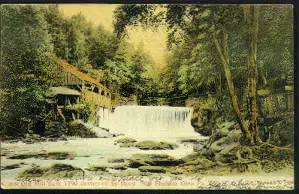 One of the first substantial buildings in Shohola Township was a mill constructed in 1790 on the Shohola Creek where the Twin Lakes Road bridge is located today. The mill, with a wooden dam was build by Richard VanZant and Tobias Robinson. They also erected a store, operated by David Hickock, located just east of the mill. The Shohola Glen Sawmill remained until 1933 and was used to hoist the coaches up Hemlock Hill on the Switchback Gravity Railroad at the Shohola Glen Amusement Park from 1886 until 1907. There was little additional development in Shohola until the arrival of Erie Railroad construction crews in 1847.
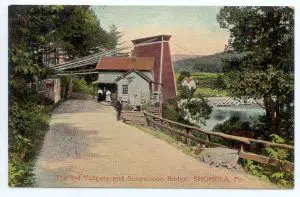 Shohola was a major crossing point on the Delaware River for thousands of years. The Quiwomink (Wyoming) Valley trail crossed the Hudson River near Newburgh, the Delaware River at Shohola and the Susquehanna River at Wilkes-Barre. With the opening of the Delaware and Hudson canal in 1829 a ferry crossing was established the next year. When the the Erie Railroad began operation in 1850 a bridge crossing became essential and a suspension bridge designed by John Roebling was constructed in 1855. The bridge, repaired three times lasted until the second world war. The opening of the Erie Railroad with twelve miles of track in the township, ushered in an age of prosperity for Shohola.Christopher Gibson and John Sterling under The Great Shohola Viaduct built
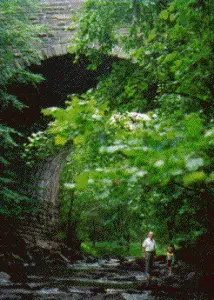 in 1870 by Jacob Pershbacher of German Hill. The creation of the railroad bed in Shohola township was a fantastic feat of engineering, costing more than $1,000,000 to blast and cut along the rocky shores of the Delaware River. Railroad stations were constructed in Pond Eddy, Middaugh’s, Parker’s Glen, Handsome Eddy and a beautiful Victorian depot constructed in Shohola. An original wooden trestle for a single broad gauge line (6 foot until 6/22/1880) was replaced by a large single arch viaduct constructed of hand cut stone by Jacob Pershbacher of German Hill in 1870. The new viaduct allowed two standard gauge (4′ 8.5″) lines to cross the Shohola Creek, eliminating the last of the dangerous single track gauntlets, and creating a double track on the entire main line. All of the stations have been destroyed by flooding or razed, but the Great Shohola Viaduct, although damaged by hurricane Diane in August of 1955 remains. The viaduct was used to shelter a large roller skating platform and dancing floor at the Shohola Glen Amusement Park 15 years later. If you look carefully, you can see the bolts protruding from the walls that supported the platform 100 years ago.
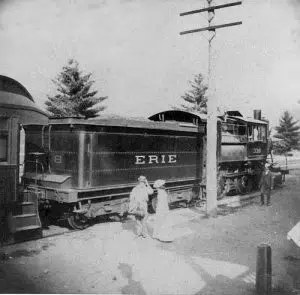 Shohola Township has been the location of twelve railroad accidents. By far the worst was the Great Shohola Train Wreck of the the United States Civil War on Friday, July 15, 1864. More than 300 soldiers were killed or injured in the accident. Another accident occurred on April 17, 1868 at Carr’s Rock killing or injuring almost 120 passengers. The Erie Railroad changed the name of the community of Carr’s Rock to Parker’s Glen after the accident in an attempt erase the tragedy from memory. E. S. Parker was a major stockholder of the blue stone quarrying business in the village. Parker’s Glen was completely destroyed by flooding of Hurricane Diane in August of 1955. In 1871 an incorrect switch setting caused the “Lightning Express” to leave the tracks just fifty feet before the Great Shohola Viaduct. Major tragedy was averted as the express was only traveling at fifteen miles per hour. In 1874 a boulder struck a freight car and sent five cars down the embankment and into the Delaware River at Pond Eddy. Tragedy was again averted as the freight train was scheduled to run in place of a passenger train that was delayed. A second accident at King and Fuller’s Cut occurred in 1877 just thirteen years after the great Civil War accident. On August 13, 1888 at 1:40AM the citizens of Shohola were awakened by screams of agony as the Chicago Express plowed into a freight train. Seventeen cars were thrown over the eighty foot embankment into the Delaware River. On July 29, 1899 the “Buffalo Express” traveling at 50 MPH, crashed into a slow moving freight train. The sleeping cars caught fire and debris was everywhere. Other accidents occurred in 1958, 1964 at Shohola, 1976 at Pond Eddy, 1977 at Handsome Eddy and 1978 at Parker’s Glen. The 1978 accident spilled three boxcars loaded with sifted flour. Some of the flour dumped into Twin Lakes Creek and the Delaware River creating a thick paste.
A railroad caboose was placed in Shohola to commemorate the Robert E. Peary expeditions to the North Pole. In 1898 Eben Thomas, President of the Erie Railroad presented Peary with a caboose to be use as living quarters for his expeditions. Erie caboose 4259 was placed on the deck of the steamship Windward which Peary used as his headquarters for many journeys to explore the northland. In July 1902 the caboose was returned to the Erie Railroad and brought to Shohola to attract visitors to the area and the amusement park. It was decorated with scenes of the Arctic region and was popular with visitors.
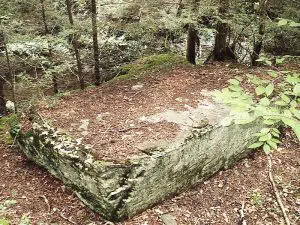 The construction of the broad gauge (6 Foot until 6/22/1880) Erie Railroad made it possible to ship vast quantities of cut Shohola Bluestone quarried along the Delaware River in Shohola township. Large quarries were located in Pond Eddy, Parker’s Glen and Shohola, with smaller quarries located all along the railroad and the Delaware river. The unique quality and color of the hard, fine grained stone was popular because it did not become slippery when wet and dried quickly. Shohola Bluestone was used to build sidewalks and buildings in major cities through out the eastern United States and millions of tons were shipped overseas for construction, Especially popular in Havana, London Paris and New York, there are many remaining bluestone sidewalks around the world. In Pike County both Milford and Shohola have significant existing bluestone sidewalks, most in excellent condition after being exposed and worn for well over 100 years. Can the Portland Cement and concrete industry make a similar claim?
One very large glacier deposited uncut bluestone, located just outside of a cave in Shohola Glen, is known as the “Shohola Stone”. It was considered by the Lenni Lenape to be the center of the universe, and would provide supernatural powers to all who stood on the stone with true reverence and humility. If you look carefully, you can find very old and weather worn carvings around the stone. The Shohola Stone, also know as the “Great Stone of Everlasting Peace” or simply the “Peace Stone”, is sometimes incorrectly referred to as the Lenape Stone or Lenape Flat Stone.
Many homes in Shohola use Shohola Bluestone for sidewalk, hearth and porch construction. The main entrance of St. Jacobi’s Church in Shohola has the largest cut bluestone slab know to exist.
An article on page 40 of the October 2008 issue of “Smithsonian Magazine”, discusses the beauty and mystical healing power of Bluestone in the construction of Stonehenge, in southwestern England.
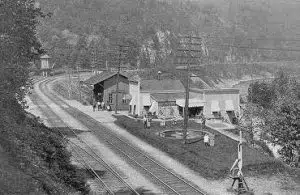 Hurricane Diane the greatest natural disaster to strike Shohola Township, devastated the area in August of 1955. Major roads were destroyed and minor roads simply disappeared. The entire community of Parker’s Glen was obliterated and flushed into the Delaware River. Many small dams collapsed adding to the disaster. Most bridges were washed out and lost in the torrent. All of the communities of Shohola Township were cut off from the outside world as electric and communications were out. Most homes were flooded with sewage systems backed up. Area summer camps were unable to feed thousands of children and were also unable to send them home. The need for immediate rescue brought a tremendous response from residents and unselfish acts of heroism were frequent. The only communication was by amateur “HAM” radio or public service radio. Shelters were set up at schools, churches and fire halls. Air Force helicopters brought children out of isolated camps and dropped food to others. The destruction of the Lake Greeley Dam on Taylortown Creek feeding the Shohola Creek caused major damage to Camp Shohola for Boys and significantly contributed to the flooding downstream. The cleanup took years and the effects of the flooding permanently changed the geography of Shohola Township. Better designed bridges and dams constructed after the flooding should help preserve the property in the township.
I have been exploring Shohola Township for more than 50 years and have visited and extensively researched all of the communities and areas mentioned on this page. My family along with the Wood family of Woodtown, rescued stranded residents trapped in Parker’s Glen in 1955 and we witnessed the extensive flooding and damage to Parker’s Glen, Shohola and Twin Lakes and Lake Greeley.
I have hundreds of pictures of Pike County and Shohola Township on my College web site. Click on the Pike County Link and then the glen link.
If you have any questions, or would like your Shohola related link on this page, please E-mail webmaster@shohola.org