
 570.371.4760



Camp Shohola’s activity schedule combines choice with repeated instruction. The published program uses five instructional periods a day, divided between A Days and B Days, allowing campers to choose up to ten activities. Parents can help by discussing interests and questions beforehand while leaving room for their son to make choices with the camp team.
The goal is a schedule he wants to participate in, not a list designed to impress someone at home. A familiar activity can provide a comfortable starting point, while another choice can open the door to something new.
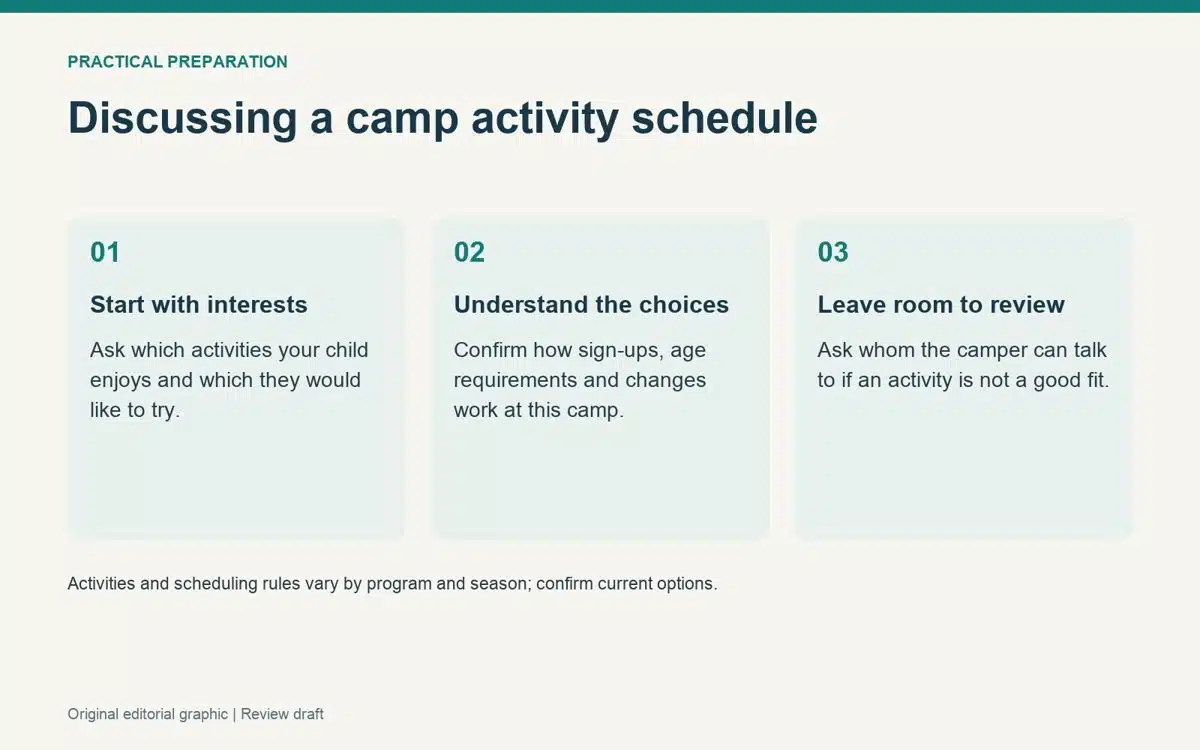
Understand the scheduling model first
The Camp Shohola program page explains that campers can select up to five A-Day activities and five B-Day activities. Repeated periods give boys time to receive instruction and develop skills rather than starting an entirely new activity every day.
The page also describes opportunities to change choices during the first week, with the aim of following through on the chosen schedule for up to four weeks. Campers staying longer receive a new schedule at the session changeover.
Treat that as the published framework and confirm the current process with the camp. Ask when choices are made, how staff help new campers and how any scheduling limitations are handled. Do not promise a place in a particular activity before the camp confirms it.
Start with three kinds of interest
Instead of filling ten spaces immediately, ask your son to make three short lists:
- Already enjoy: an activity he would be happy to practice regularly.
- Curious about: something he has seen but has not had much chance to try.
- Need to understand: an activity that sounds interesting but raises a question.
The third list is especially useful. A boy may dismiss an activity because he assumes everyone else will be experienced, or choose it without understanding what instruction involves. Those are questions staff can answer.
Avoid assigning a category to his personality. A sports enthusiast may enjoy a creative activity; a boy interested in technology may also want time on the water. The lists should reflect his own curiosity.
Look across the six departments
Shohola’s published program groups activities into LandSports, WaterSports, Outdoor Adventure, Equestrian, CommTech and Arts. That variety gives families a practical way to explore beyond the first two activities that come to mind.
Ask what a session in each department actually involves and whether there are age, experience or other requirements. The camp’s parent FAQ states that swimming is mandatory. Confirm how that requirement fits the current selection process before treating all ten choices as completely unrestricted.
Some activities or trips may have separate arrangements. If a particular option is important to your son, ask about eligibility, scheduling and any additional requirements directly rather than assuming it is included in every session.
Build a discussion draft, not a guaranteed timetable
A simple worksheet can help your son explain his preferences to staff.
| Choice to discuss | Why he wants it | Question to ask |
|---|---|---|
| Familiar activity | Enjoyment or a skill he wants to practice | How is instruction organized for different experience levels? |
| New activity | Curiosity or a chance unavailable at home | What should a beginner expect? |
| Creative or technical interest | Making, designing, performing or learning | What projects or skills are part of the current program? |
| Alternative choice | A genuine second preference | When might this fit if the first choice is unavailable? |
This worksheet is not an official selection form. It is a way to arrive with meaningful preferences and useful questions, without expecting the camp to reproduce a parent-made timetable.
Think about the whole day
Instructional periods are only part of camp life. The typical-day schedule also includes meals, cabin cleanup, rest time, free time or general swim, and evening activities.
That matters when a child worries that selecting a few favorite activities will determine every friendship or every hour of the summer. Ask the camp how instructional groups, cabin life and wider activities fit together.
It also helps parents avoid trying to squeeze every possible experience into the ten instructional choices. Camp offers a daily rhythm as well as a menu of activities. A schedule can be worthwhile without including every department.
Talk about changing an activity constructively
A first session can feel unfamiliar even when the choice is a good fit. Ask your son what he would do if an activity felt difficult or different from what he expected. A useful first step is speaking with the instructor or counselor about the concern.
Shohola’s published first-week flexibility gives families a reason to ask how changes work. It is not a promise that any activity can be replaced at any time. Discuss the difference between getting help with a new skill and discovering that a selection is unsuitable.
If your son is uncertain before arrival, let the camp team know. Ask how staff guide a new camper who has a long list of interests or struggles to choose between options.
Questions families often ask
Does my son choose something new every day?
The published model uses A-Day and B-Day schedules with repeated instructional periods. Confirm the current details for his session.
Can he change his mind?
The program page describes changes within the first week. Ask how that process works and what limits apply.
Should parents pick the activities?
Help him understand the options and prepare questions. His interests should lead the conversation, with the camp guiding the actual schedule.
Can a beginner choose an unfamiliar activity?
Ask the camp about that specific activity’s instruction, eligibility and any requirements. Do not assume all options work the same way.
Where can we check an important preference?
Contact Camp Shohola before making promises about a particular activity. Bring a few interests, alternatives and questions so the team can explain how the current program fits your son.